
Syracuse and the surrounding New York area
Water Service Line Repair and Replacement in Onondaga County
Find out whether the pipe carrying water into your house has failed, which side of the curb stop it failed on, and what replacing your half of it actually involves here.
Water Service Lines quote
A service line quote is only worth comparing when it says what the pipe is made of and how deep the new one goes. Tell us what you are seeing and roughly when the house was built, and we will put you in front of licensed, insured contractors who settle that before they price it.
Would you rather talk it through? Call (315) 640-3590, answered 24/7.
$100 off your first job
Credited by us on your first booked job.
- One credit per customer per property, on your first booked job.
- Valid through December 31, 2026.
Mention this offer when you book. Full terms.
The pipe from the curb stop to your basement
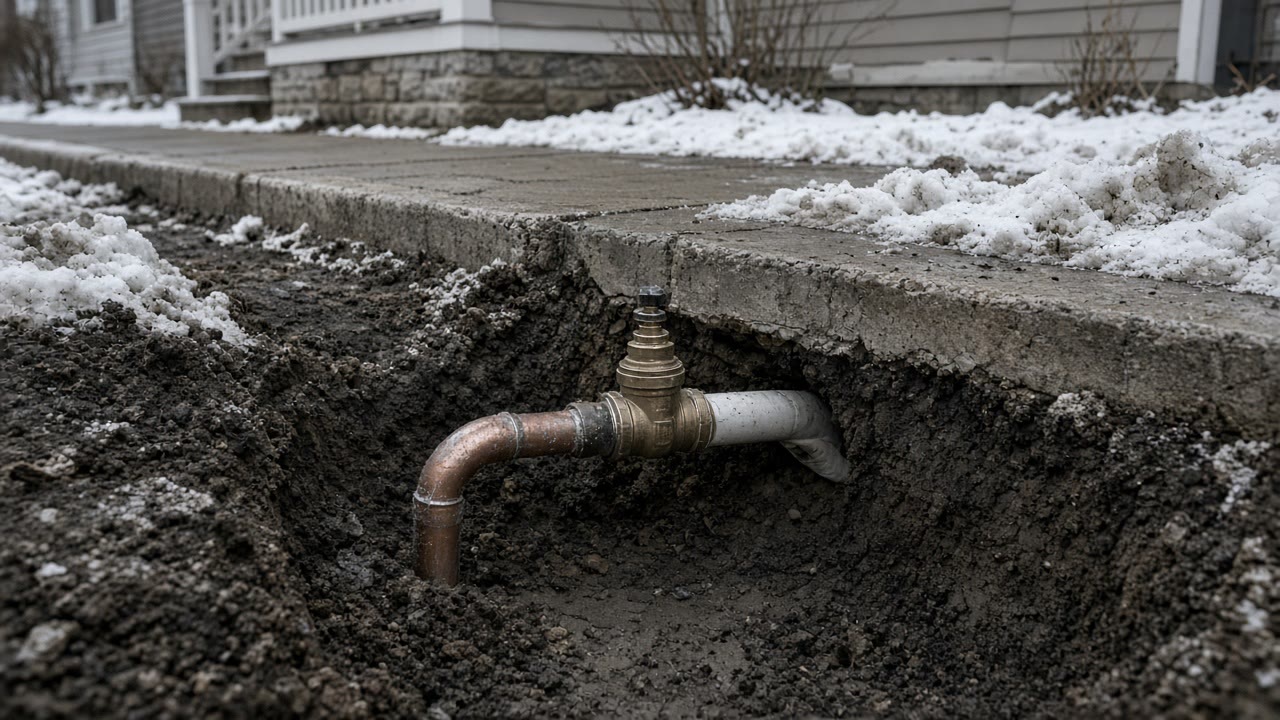
The water service line is the single pipe that brings drinking water from the street into your basement, and this is work on the part of it you own. The City of Syracuse divides every service into three parts and names an owner for each: the main out to the curb box is the City's, the curb box to the meter is the homeowner's, and the meter itself belongs to the City. Outside the city line OCWA draws the same boundary in a different place, owning the pipe to the shutoff valve at the property line and leaving everything from the outlet side of that valve inward to the customer. So the pipe under your front lawn is almost certainly yours, whatever the water bill implies. Replacing it means an excavation to at least 54 inches, a county permit, and an inspection before the trench closes, and in this county a homeowner is not permitted to do it themselves.
- Full replacement of the private side of the service, curb stop to the first valve inside the wall
- Lead service line replacement, including the private half that a public side program does not reach
- Galvanized service replacement where the state inventory records the line as galvanized requiring replacement
- Localized repair where one section has failed and the rest of the run is sound
- Lowering a service that sits above the 54 inch minimum cover and keeps freezing
- Open cut and pulled replacement, chosen by what sits on top of the line rather than by preference
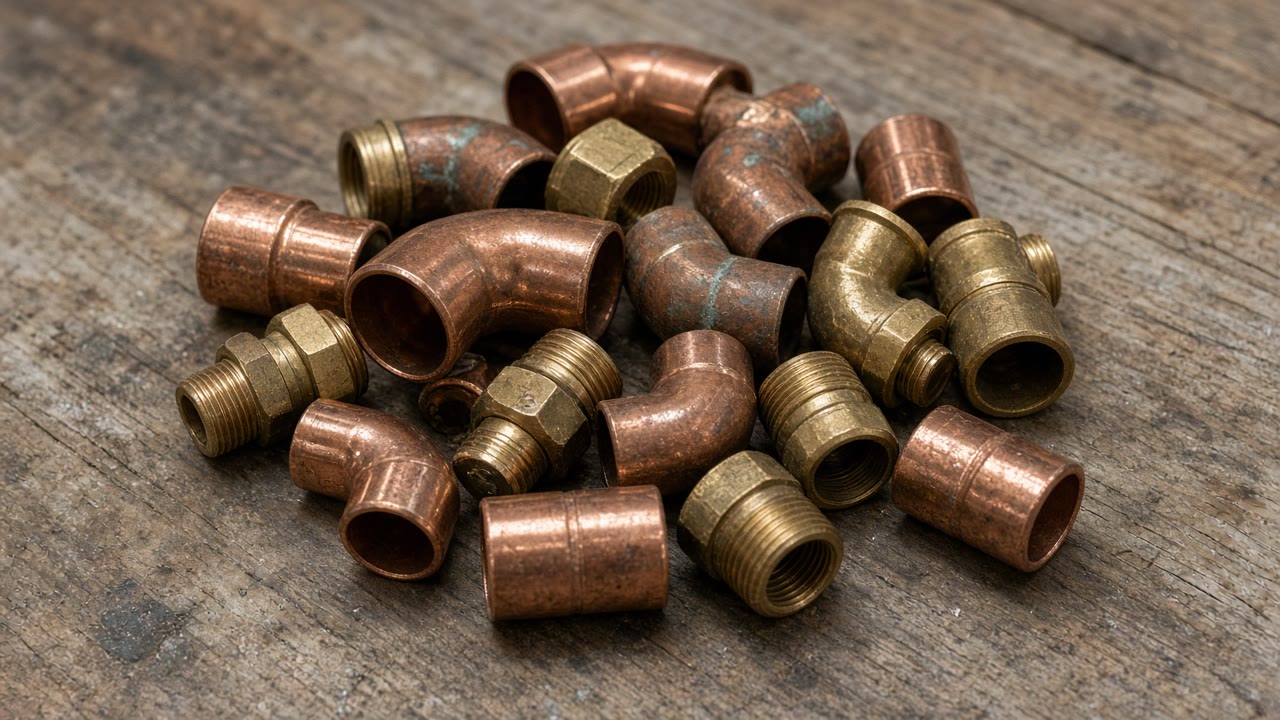
- Type K soft copper at three quarter inch minimum, which is what the customer rules specify
- Disinfection of the new line before the house drinks from it
- Capping and grouting an abandoned service at the inside and outside walls
- Meter pit work where the run from the street exceeds 150 feet
- Reinstating the lawn, driveway or sidewalk the trench crossed
What decides a service line job here
Two houses on one street can get very different numbers for the same length of pipe, and almost none of it is negotiable. What moves it is what the pipe is made of, how far it runs, what sits on top of it, and what month it is.
Which side of the curb stop actually failed
The City of Syracuse splits a service into three parts and owns two of them, the main out to the curb box and the meter, leaving everything between them to you. OCWA draws its line at the shutoff valve at the property line and is equally clear that all the plumbing and piping inside that point, valves included, belongs to the owner. So the first question is not how bad the leak is, it is whose pipe is leaking, and the water purveyor will establish that at no cost. The City runs an emergency line answered around the clock on 315-448-8360, and OCWA answers after hours on 315-475-7601.
What the pipe is made of, and whether anyone has ever looked
New York State's inventory for the City of Syracuse records 38,601 service lines, of which 17,239 are lead and 16,098 are still unknown. The split by side is the part that matters to you: the city identified 34,650 public side lines from its own historical records and none at all on the customer side, which leaves 25,526 lines on the customer side unclassified simply because nobody has looked yet. In OCWA territory the picture is sharper still, with 399 of the 415 known lead lines sitting on the customer half. Material decides whether this is a patch, a replacement, or a program you may already be inside.
Whether a replacement program reaches your street this year
Inside the city the private half may be replaced at public expense. Syracuse states it is going beyond what EPA requires and will replace private lead services at approximately 2,900 homes citywide this year, prioritizing the oldest housing stock. There is also a Water Department route in which the city hires the plumber and the cost is assessed on your property tax bill, and the city's own published advice is that hiring your own contractor may be cheaper and quicker than that route. Outside the city there is no equivalent: OCWA states it does not currently have internal funding for customer side replacements.
How deep it has to go, and what is on top of it
Minimum cover for a domestic water service in Onondaga County is 54 inches, and OCWA's customer rules land independently on the same four feet six inches while also naming the material, Type K soft tempered copper at three quarter inch minimum on services up to two inches. That depth multiplied by the length of the run is most of the excavation. A driveway, a mature tree, a sidewalk or a retaining wall over the line changes the method again, and past 150 feet from the street OCWA may require the meter to sit in a pit at the curb at least five feet deep, which the customer installs and maintains.
The month you are standing in
OCWA's customer rules say the authority is not required to install any service connection between November 15 and April 15, and that where it does agree by special arrangement the customer pays the excess over normal cost. Inside the city, the Water Department's own application aid warns that a service may take four to six weeks to install once the permit paperwork is done. Set that against 46.8 days a year on which the temperature never climbs above freezing, and a line that is failing in October is a different job from the same line in January.
Rock, and the holes the work leaves behind
Section 4.9 of OCWA's rules puts the cost of drilling, blasting or jackhammering through rock or boulders on the customer, up to three times the standard connection fee, so ground conditions are a real line item rather than a surprise. At the house end, the county makes the license holder responsible for sealing and patching any opening left in a wall, floor or ceiling by their own installation, unless there is a written agreement that the owner will do it. Both belong in the quote rather than in the final bill.
Insurance for an excavation is not insurance for a faucet
Onondaga County requires every licensed plumbing contractor actively working in the county to keep certificates of insurance on file with Plumbing Control, naming Plumbing Control as a certificate holder, covering public liability of 1,000,000 dollars, property damage of 50,000 dollars each accident with a 100,000 dollar aggregate, and New York State workers compensation. Opening a trench across a front yard is a different risk category from changing a fixture, and the underground hazard cover on that certificate is a fair thing to ask about before anyone digs.
Not sure which side of the curb stop this is?
That is answerable at no cost, and it decides whether the bill is yours at all.
The order a service line job runs in
Establish whose pipe it is before anyone quotes
One phone call decides whether this is your job at all. The City of Syracuse Water Department takes emergency calls on 315-448-8360 and OCWA's after hours service is 315-475-7601. Water surfacing in the tree lawn on the street side of the curb box is the purveyor's problem, and it is worth ruling that out first: nearly six in ten gallons entering the city system in 2024 were never billed to anyone, which is the scale of leakage a century old network carries on its own account.
Find out what your half is made of
The City publishes an address level lookup that classifies each line as non lead, lead, galvanized requiring replacement or unknown, and asks residents showing unknown to submit photographs of the pipe at the meter. OCWA publishes an equivalent inventory map and will send an employee out for a five minute visit to identify the pipe. Where OCWA confirms a lead line it covers the first tap water test, which a laboratory holding New York State certification would otherwise charge 20 to 100 dollars for.
The permit, and who is allowed to hold it
Onondaga County Local Law No. 9 of 1988 restricts plumbing permits to holders of a Certificate of Competency from the county Examining Board as Master Plumbers or Plumbing Contractors Class B or C, and obtaining a permit on behalf of anyone else is itself an offense carrying up to 500 dollars or 100 days per violation. Even inside the city the permit number is pulled from county Plumbing Control on 315-435-6614. The county's published documents describe the city boundary on that license in two different ways, so for a city address the honest step is to confirm the class with Plumbing Control rather than take anyone's word for it.
Tell the water authority before the trench opens
This is the sequencing step that saves the most money and gets skipped the most often. OCWA asks anyone planning to replace their portion to call 315-455-7061 extension 3139 so records can be updated, and that notice is what lets both halves be done in one open trench. OCWA will also shut the water off at the road while the work runs, so nobody needs to touch the curb stop, which under section 4.4 of the customer rules is reserved to an employee of the authority.
Excavate, lay the new line at depth, deal with the old one
The new service goes in at 54 inches of cover minimum, in Type K soft copper, and enters the wall horizontally at a depth that keeps it out of the frost. The county also requires that where a service is removed or relocated the former pipe or sleeve is capped at both the inside and outside walls and the openings grouted full. An abandoned lead service left connected and uncapped is a code failure, and it is worth asking what happens to the old pipe before the work starts.
The inspection happens before the hole is filled
Onondaga County requires a permit before any work except an emergency, an emergency permit on the first business day afterward, and states that work cannot be covered, backfilled or concealed until Plumbing Control has inspected it. A contractor who fills the trench on a Saturday night has made the work uninspectable. In the city that same open trench is also your proof for the next step, since the Water Department accepts its own basement inspection, a licensed plumber's inspection or a receipt as evidence the private side was replaced.
Disinfect, then flush hard
The county requires all newly installed potable lines, and any part of an existing system that has been altered, extended or repaired, to be disinfected before use. Flushing afterward matters for a second reason in the city: the water is dosed with orthophosphate at 1.75 milligrams per liter to build a protective film inside the pipe, and digging near a line or replacing half of it can knock that film loose, so lead can run higher for a while after the work than before it.
Claim the public side on the proof
The ordering here runs against instinct. The City of Syracuse Water Department states that it will replace the public portion of a lead service once the owner has proof the private portion has already been replaced. Private side first, public side on the evidence, which is why the inspection two steps back is worth arranging rather than assuming.
What water service lines looks like
What this covers, and where the public pipe takes over
When you may not need this at all
- If the wet patch is in the tree lawn on the street side of the curb box, this is not your pipe and not your bill. Report it to the City on 315-448-8360 or to OCWA on 315-455-7061 before anyone quotes you for an excavation.
- A street wide pressure drop or a burst of rusty water usually has a cause outside your house. The city's own data records about 200 main breaks a year across more than 500 miles of pipeline, and 47 percent of them fall in the four months from December through March. If the neighbors have it too, this is a flushing job rather than a plumbing job.
- If your address shows as unknown on the city lookup or OCWA's inventory map, the next step costs nothing at all. Both publishers ask for photographs of the pipe where it enters the basement, and OCWA will send someone out for a five minute visit. Resolve that before paying anyone to investigate the material.
- Inside the city, check the lookup and the construction dashboard before commissioning a private lead replacement. Roughly 2,900 homes are scheduled for private side replacement this year, oldest streets first, and if yours is in that phase the work may already be coming.
- Where the line is sound but shallow, the answer may be depth rather than a new service. The county cautions its own designers that insulation board over a shallow line does not work in Onondaga County, because a line with little flow generates no heat of its own. A proposal to wrap a shallow line instead of lowering it is a proposal the county's guidance says will not hold.
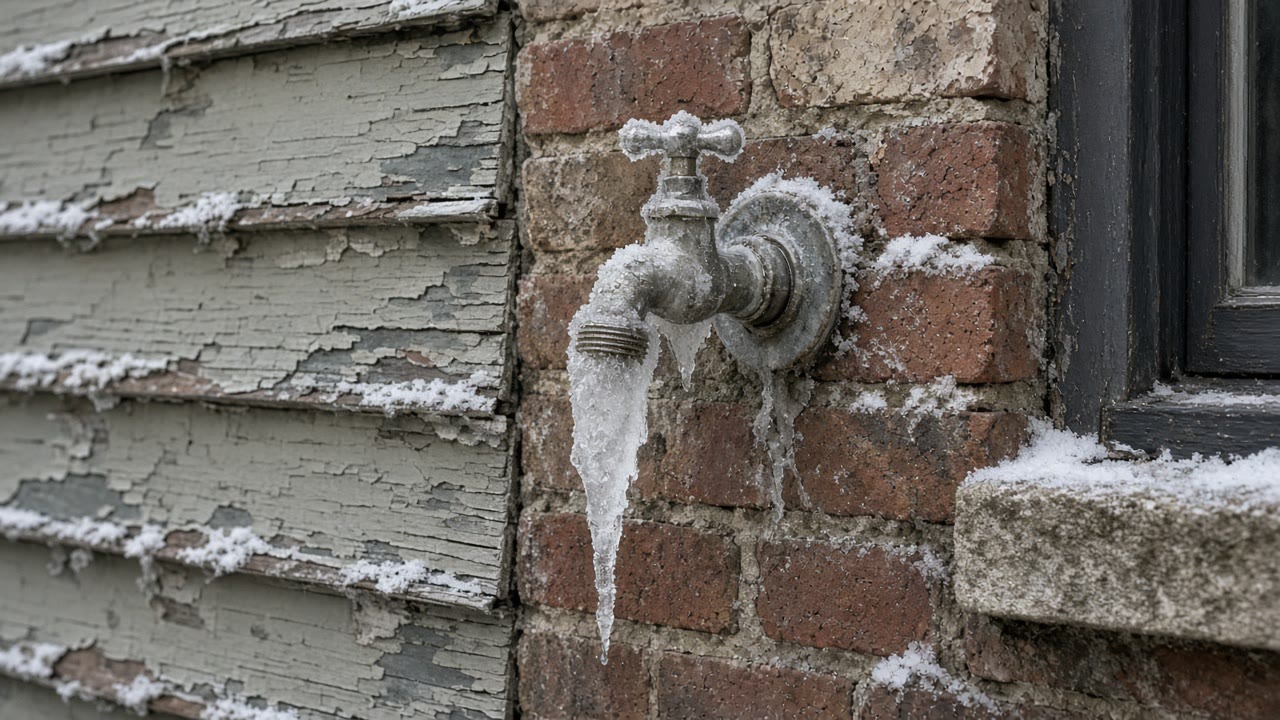
- A line that froze once and thawed may need nothing this winter except a valve you can find in the dark. OCWA requires two customer owned shutoffs, the first no more than 12 inches inside the building wall, and finding and labeling that one is an afternoon rather than a job.
What is out of scope
- Sanitary sewers and building drains. The pipe leaving the house has a different owner rule, a different depth rule and a different trade problem behind it, and it is arranged separately.
- Anything on the street side of the curb stop or the property line valve, which belongs to the City of Syracuse or to OCWA and is theirs to repair.
- Operating the curb stop itself. OCWA reserves that valve to its own employees and lists tampering with authority equipment as grounds for discontinuing service.
- Removing or resetting a City of Syracuse water meter, which the city states may only be removed by meter room personnel.
- Private wells, well pumps and pressure tanks, which are not connected to a public service at all.
- Fire service lines and yard piping, which the county puts at 66 to 72 inches of cover and treats as a separate class of work.
Service line work across the metro
- Water Service Lines in Syracuse
- Water Service Lines in Solvay
- Water Service Lines in East Syracuse
- Water Service Lines in Salina
- Water Service Lines in Liverpool
- Water Service Lines in North Syracuse
- Water Service Lines in Camillus
- Water Service Lines in Clay
- Water Service Lines in Cicero
- Water Service Lines in DeWitt
- Water Service Lines in Manlius
- Water Service Lines in Fayetteville
- Water Service Lines in Baldwinsville
- Water Service Lines in Marcellus
- Water Service Lines in Skaneateles
- Water Service Lines in Jamesville
What homeowners ask before replacing a service line
Can I replace my own water line to save the labor?
No, and this is the clearest rule in the trade here. The conditions on the Onondaga County homeowner plumbing permit state plainly that homeowners are prohibited from doing any type of plumbing work outside the house, naming water services as the example. Inside the foundation you can pull your own permit and replumb a bathroom. The pipe in the front yard is not on that list, and only a holder of a county Certificate of Competency may take out the permit for it.
How do I find out whether my line is lead?
Look your address up first. The City of Syracuse publishes a service line lookup that classifies each address as non lead, lead, galvanized requiring replacement or unknown, and OCWA publishes an inventory map for the towns it serves. If the record says unknown, which it does for 25,526 lines on the customer side in the city, the way it gets resolved is a photograph of the pipe where it enters the basement, or a five minute visit from an OCWA employee. Where OCWA confirms lead, it covers the first tap water test.
Will the city or the water authority pay for it?
It depends which side of the city line you are on. Syracuse is replacing private lead services at approximately 2,900 homes citywide this year at city expense, and separately offers a program in which it hires the plumber and assesses the cost on your property tax bill, while noting in its own report that hiring your own contractor may be cheaper and quicker. OCWA states it does not currently have internal funding for customer side replacements, so outside the city the private half is the homeowner's cost.
Why will nobody fill the trench in tonight?
Because the county does not allow it. Plumbing Control requires a permit before any work except an emergency, an emergency permit on the first business day after, and states that work cannot be covered, backfilled or concealed before an inspection has been done. An open trench overnight is the rule working rather than a contractor being slow, and a hole filled before the inspector sees it has to be opened again.
What actually changes in 2027?
The federal Lead and Copper Rule Improvements take effect on November 1, 2027, and the lead action level drops from 15 parts per billion to 10. The city's four most recent six month rounds came in at 10, 9, 12 and 6 parts per billion, so three of the four sit at or above the level that is coming while all four are below the one in force today. The same rule requires systems to identify and replace lead pipes within ten years, which is why the question stopped being whether the pipe gets replaced and became who pays for your half, and in which year.
How long does the whole thing take?
Nobody here will promise you a date, and a contractor who does before seeing the ground is guessing. The published figures are worth planning around though. The City of Syracuse Water Department's own application aid warns that a service may take four to six weeks to be installed after the permit is issued, and OCWA's customer rules say it is not required to install service connections at all between November 15 and April 15 except by special arrangement at extra cost. A line that is limping in autumn is far easier to deal with in autumn than in February.
Tell us what the water is doing
Pressure gone, a wet patch in the yard, or a lookup that came back lead. Each one starts a different job.