
Finding a Hidden Water Leak Before You Pay Anyone
Start with the toilets, then the meter, and both checks cost a few dollars at most. OCWA's published method is to put a few drops of food coloring in the tank, wait about 45 minutes and look in the bowl: color in the bowl means the toilet is emptying and refilling itself, and the part is usually a flapper. If the toilets are clean, turn every fixture off and watch the meter. If it still moves, water is leaving somewhere between the meter and a fixture, and that is the point at which a search is worth paying for.
Already know you need someone out? Call (315) 640-3590, answered 24/7.
The order to rule things out, cheapest first
Dye test every toilet
A few drops, 45 minutesOCWA's method: food coloring in the tank, wait, then look in the bowl. Color in the bowl means the flapper is passing water, and that part is a few dollars.
Watch the meter with everything off
Fifteen minutesOCWA sets meters just inside the cellar wall at a point controlling the entire supply where the run from the street is under 150 feet, so one dial covers the whole house.
Rule out summer condensation
Costs nothing, and seasonalThe mean July dew point here is 61.1 degrees Fahrenheit, with the 90th percentile hourly dew point averaging 69.1 degrees, and lake sourced water runs colder, so a cold supply line sweats in ordinary July air.
Check the places the code says pipe should not be
Before opening anythingSection 305.4 of the Plumbing Code of New York State names outside walls, attics, crawl spaces and anywhere subject to freezing as places supply pipe should not run unprotected.
If the wet ground is out front, find the curb box
One phone callWater surfacing on the street side of the curb box is the purveyor's. The City of Syracuse emergency line is 315-448-8360 and OCWA is on 315-455-7061.
Only then pay for a search
Where it is worth itFinding the water is usually cheaper than reaching it, and a leak found small is a cheaper repair than the same leak found late.
OCWA published customer advice and Customer Rules sections 5.3 and 9.2; NOAA 1991 to 2020 hourly normals for Syracuse Hancock International Airport; Plumbing Code of New York State section 305.4; City of Syracuse Department of Water.
The toilet first, because it is the most common answer by a distance
A toilet that refills itself at intervals through the night loses water continuously and silently, and it is the single most common cause of a bill that jumped with nothing visible. OCWA publishes the test: lift the tank lid, put a few drops of food coloring into the tank water, wait about 45 minutes without flushing, and look in the bowl. If the coloring has reached the bowl, the toilet is emptying and refilling itself, and the flapper is the usual culprit. The part is a few dollars, County Plumbing Control lists the repair or replacement of a toilet fill valve or flushing mechanism in kind as work needing no permit at all, and it is a reasonable first attempt for anyone comfortable lifting a tank lid. There is a second reason to hunt this down promptly in the city: the City of Syracuse bills sewer on actual water consumption at 1.25 dollars per 100 cubic feet on top of water at 3.44 dollars per 100 cubic feet for city customers, so water quietly running into a bowl is charged twice. OCWA is blunter still, listing waste of water through imperfect facilities, including a customer's failure to fix leaking pipes, among the grounds on which it may discontinue service.
Then the meter, with everything in the house turned off
The meter is the one instrument that sees the whole house at once, which is exactly what you need when nothing is visibly wet. OCWA's rules allow the meter to be set inside a building where the service pipe from the street line to the point of use does not exceed 150 feet, sited just inside the cellar wall at a point controlling the entire supply, so in most houses a single dial covers everything past that point; where no suitable indoor location exists or the run exceeds 150 feet, the meter may sit in a pit near the curb box at least 5 feet deep, installed and maintained by the customer. The county also requires a valve on both sides of a meter and asks for meters to be near the point of entry, along an exterior wall and conveniently accessible for reading. Turn off every fixture and appliance that uses water, including an ice maker and a humidifier, then read the meter, wait a quarter of an hour and read it again. Movement means water is leaving the system between the meter and a fixture. No movement over a longer test, with the bill still high, points back at intermittent use, which is the toilet again. In the city, remember the meter is City property and may only be removed by meter room personnel, so reading it is the extent of your involvement with it.
A wet pipe in July is usually not a leak at all
This one saves people real money every summer. The NOAA 1991 to 2020 hourly normals for Syracuse Hancock International Airport give a mean July dew point of 61.1 degrees Fahrenheit, with the 90th percentile hourly dew point averaging 69.1 degrees in July and reaching 71.1, and August averaging 60.2. The water inside your cold supply pipe comes from Skaneateles Lake in the city, and from Otisco Lake or Lake Ontario in OCWA territory, all of which run well below those temperatures in summer. A cold pipe in humid basement air collects condensation on the outside, drips onto the floor or onto the joist below, and looks exactly like a pinhole leak. Two questions separate them. Is the wet pipe a cold line rather than a hot one, and does the problem disappear in October. If the meter is not moving with everything off, the supply system is not losing water, and the answer is ventilation, a dehumidifier or pipe wrap rather than a plumber. The same logic applies to water appearing on a ceiling below a roof, a chimney or a bathroom: a still meter means the money is better spent on the building.
Wet ground outside, and the valve that decides whose bill it is
A soft or unusually green patch in the lawn in the line between the street and the house is a service line leak until proven otherwise, and the first thing to establish is which side of the curb box it is on. The City of Syracuse divides a service into three parts and owns two of them, the main out to the curb box and the meter, leaving the run between them to the homeowner. OCWA owns from the main to the shutoff valve at the property line and puts everything from the outlet side of that valve inward on the customer. Water surfacing on the street side of that boundary is theirs to chase and costs you nothing to report: the City's emergency line is answered around the clock on 315-448-8360 and OCWA is on 315-455-7061, with an after hours service on 315-475-7601. It is worth ruling out, because a distribution system does lose water on its own account. In 2024, 13,487.72 million gallons entered the city system across more than 500 miles of pipeline and 5,584.94 million gallons were billed, with the remainder going to firefighting, street sweeping, construction, flushing, main repairs and system leakage. OCWA, for its part, reports unaccounted for water at less than 18 percent of total output and credits leak detection work that finds leaks while they are still small, which is the whole argument for looking early.
Where to look inside, according to the code
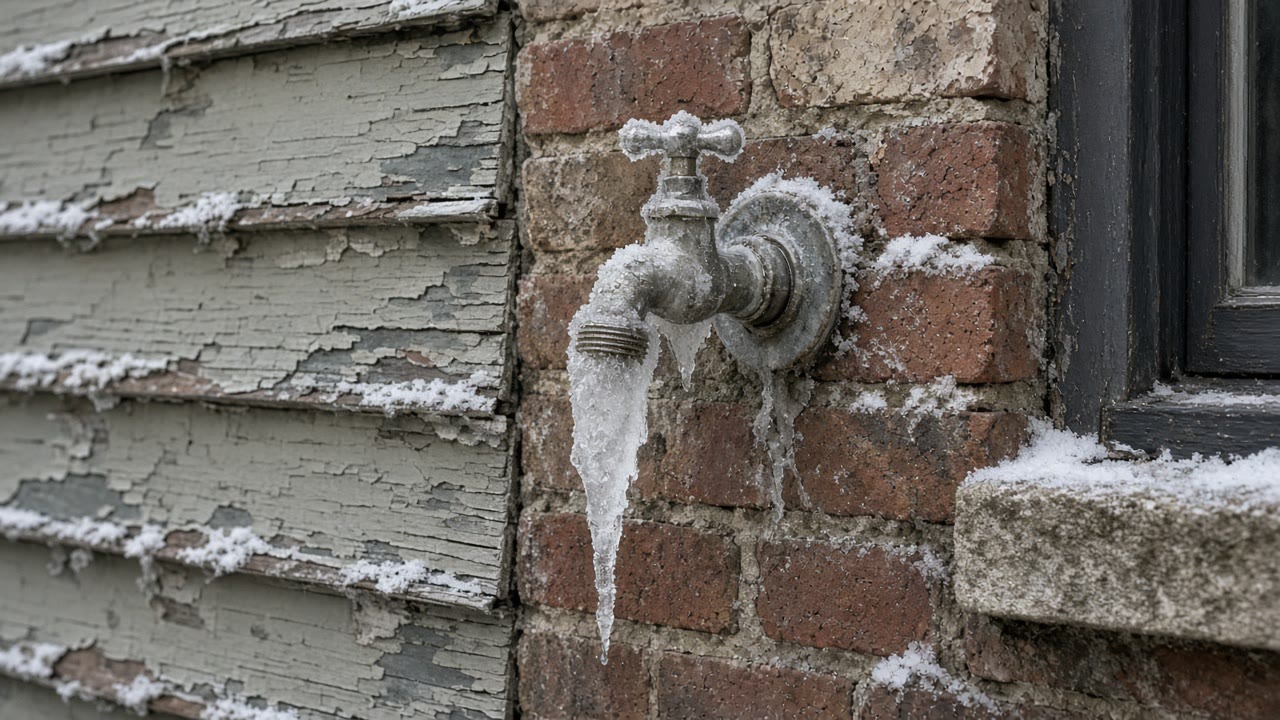
When the meter says water is going somewhere and nothing shows, the code tells you where to search first, because it names the places pipe should not have been run. Section 305.4 of the Plumbing Code of New York State states that water, soil and waste pipes shall not be installed outside a building, in attics or crawl spaces, concealed in outside walls, or in any other place subject to freezing temperatures, unless adequate provision is made to protect them by insulation or heat or both. A supply run buried in an exterior wall is a code problem before it is a leak, and it is also the run most likely to have split in a cold snap and to be weeping slowly ever since. Outside, the equivalent clue is depth: a service with less than the 54 inches of cover the county requires is the one that froze, and the county's own guidance warns that insulation board over a shallow line carrying little flow is not effective here, because such a line has no self heating effect. A leak generally has a cause, and the cause is usually a place rather than a random piece of pipe.
When the search turns into an excavation
If the leak is on the buried service, the rules change and so does who is allowed to hold the shovel. Onondaga County prohibits homeowners from doing any type of plumbing work outside the house, naming water services as the example, and only a holder of a Certificate of Competency from the county Examining Board may obtain the permit. Anyone intending to excavate to install sewers or water lines must furnish proof of insurance for underground operations, the U Hazard, to Plumbing Control, alongside the public liability, property damage and workers compensation certificates every licensed plumbing contractor must keep on file. And the hole stays open until it has been looked at: a permit is required before any work except an emergency, an emergency permit must be obtained on the first business day following, and work cannot be covered, backfilled or concealed before Plumbing Control has inspected it. Afterward, any potable line that has been newly installed, altered, extended or repaired must be disinfected before use. If your own checks have got as far as a moving meter and a wet patch, that is exactly the point to hand it over: tell us what you have found and we will put you in front of licensed, insured contractors who work under their own permits.
Sources used in this guide
OCWA's published method for finding a toilet leak is to lift the tank lid, place a few drops of food coloring into the tank water, wait about 45 minutes, and check the bowl: if the coloring shows up in the bowl the toilet is emptying and refilling itself and the flapper may need replacing. OCWA also lists waste of water through imperfect facilities, including a customer's failure to fix leaking pipes, as grounds on which it may discontinue service.
Source: Onondaga County Water Authority, accessed 2026-09-13
Onondaga County Plumbing Control states that the only instance where a plumbing permit is not required is where a fixture such as a faucet or shower head is replaced with one that has the same flow rating as the original, and lists the repair or replacement of a faucet, flush valve, supply tube, individual fixture stop, toilet fill valve or flushing mechanism that is in kind to what you currently have as not requiring a permit.
Source: Onondaga County Department of Water Environment Protection, accessed 2026-09-13
The City of Syracuse 2024 Annual Drinking Water Quality Report sets the basic price of water at 3.44 dollars per 100 cubic feet for city customers and 5.17 dollars per 100 cubic feet for non city customers, with a minimum charge of 44.72 dollars per quarter per unit for customers using less than 1,300 cubic feet, and sets the sewer rate at 1.25 dollars per 100 cubic feet with sewer bills based on actual consumption.
Source: City of Syracuse Department of Water, accessed 2026-09-13
Section 5.3 of OCWA's Customer Rules allows the meter to be set inside a building where the service pipe from the street line to the point of use does not exceed 150 feet, sited just inside the cellar wall at a point controlling the entire supply. Where no suitable indoor location exists or the service pipe exceeds 150 feet, the Authority may require the meter to be set near the curb box shutoff in a pit at least 5 feet deep with a suitable cover, owned, installed and maintained by the customer. Crawl space settings need approval and at least four feet of headroom.
Source: Onondaga County Water Authority, accessed 2026-09-13
Section 5.4.H of the Onondaga County Requirements for Implementation states that where line pressure on service pipes exceeds 80 pounds per square inch gauge pressure in OCWA territory, an approved pressure reducing valve must be installed on the inlet side of the water meter. Section 5.4.G requires a valve on both sides of any water meter and requires meters to be located near the point of entry of the water service, along an exterior wall, and conveniently accessible for reading.
Source: Onondaga County Examining Board for Plumbers, accessed 2026-09-13
The City of Syracuse Annual Drinking Water Quality Report for 2024 states that the meter is the property of the City of Syracuse and may only be removed by meter room personnel, and that about 98 percent of the city's water meters have been upgraded to the radio read system, which is mandatory.
Source: City of Syracuse Department of Water, accessed 2026-09-13
The NOAA 1991 to 2020 hourly climate normals for Syracuse Hancock International Airport give a mean July dew point of 61.1 degrees Fahrenheit, with the 90th percentile hourly dew point averaging 69.1 degrees in July and reaching 71.1 degrees. August averages 60.2 degrees. Syracuse's water is drawn from Skaneateles Lake, and OCWA's from Otisco Lake and Lake Ontario, all of which run well below those temperatures in summer.
Source: NOAA National Centers for Environmental Information, accessed 2026-09-13
The City of Syracuse Department of Water divides every water service into three parts and names the owner of each: the water main to the curb box, the shutoff near the road, is owned by the City and is the public portion; the curb box to the water meter in the basement is owned by the homeowner and is the private portion; and the water meter itself is owned by the City. The same document adds that the homeowner is responsible for the valves and other pipe fittings on either side of the meter.
Source: City of Syracuse Department of Water, accessed 2026-09-13
Onondaga County Water Authority states that ownership of a water service line is shared: OCWA owns the portion from the water main to the shutoff valve at the property line, and the customer is responsible for the portion from the outlet side of that shutoff valve to the water meter or main shutoff valve inside the home, plus all internal plumbing and fixtures.
Source: Onondaga County Water Authority, accessed 2026-09-13
The City of Syracuse Department of Water publishes an emergency line answered around the clock on 315-448-8360, alongside its main office number 315-448-8340, from 101 North Beech Street, Syracuse. OCWA publishes customer service on 315-455-7061 with an after hours and weekend emergency answering service on 315-475-7601.
Source: City of Syracuse Department of Water, accessed 2026-09-13
The City of Syracuse water system is made up of over 500 miles of pipelines delivering water from Skaneateles Lake. In 2024, 13,487.72 million gallons entered the system and customers were billed for 5,584.94 million gallons, leaving 7,902.78 million gallons used for firefighting, street sweeping, construction, main flushing, water discharge, main repairs and transmission and distribution system leaks.
Source: City of Syracuse Department of Water, accessed 2026-09-13
OCWA states that it serves 340,000 residents across five Central New York counties: Onondaga, Oswego, Madison, Oneida and Cayuga. Its 2024 Consumer Confidence Report records average daily supply of 36.31 million gallons in 2024 and states that unaccounted for water was less than 18 percent of total output, which it attributes in part to leak detection work that finds leaks while they are still small.
Source: Onondaga County Water Authority, accessed 2026-09-13
Section 305.4 of the Plumbing Code of New York State, headed Freezing, states that water, soil and waste pipes shall not be installed outside a building, in attics or crawl spaces, concealed in outside walls, or in any other place subject to freezing temperatures unless adequate provision is made to protect them by insulation or heat or both, and that exterior water supply system piping shall be installed not less than 6 inches below the frost line and not less than 12 inches below grade.
Source: UpCodes, publishing the Plumbing Code of New York State 2020, accessed 2026-09-13
Section 5.5 of the Onondaga County Requirements for Implementation sets minimum cover for a building domestic water service with normal flow at 54 inches, sets building sewers at 48 inches minimum cover, sets pumped sewers and force mains at 6 inches more than frost depth which it gives as 48 inches minimum cover in Onondaga County, and sets fire service lines, yard piping and lines with little or no flow at 66 to 72 inches. It adds that designers and contractors should allow extra cover for local conditions such as wind exposure and large paved areas.
Source: Onondaga County Examining Board for Plumbers, accessed 2026-09-13
Section 5.5 of the Onondaga County Requirements for Implementation cautions designers that the use of insulation board over shallow lines that carry little flow is not effective in Onondaga County, because lines with little or no flow have no self heating effect and insulation does not prevent freezing. The same section requires water services to enter building walls horizontally at sufficient depth to avoid freezing, and on shallow foundations or slab on grade to rise above the floor immediately upon entering the building footprint.
Source: Onondaga County Examining Board for Plumbers, accessed 2026-09-13
The Onondaga County Homeowner Plumbing Permit conditions state plainly that homeowners are prohibited from doing any type of plumbing work outside the house, giving water services and building sewers as the examples, and that only the individual homeowner may install the permitted work, so the homeowner is expected to demonstrate the knowledge necessary to undertake the installation. The county's forms page describes the same permit as covering additions or alterations by an owner occupant to the plumbing inside their single family home.
Source: Onondaga County Department of Water Environment Protection, accessed 2026-09-13
Onondaga County Local Law No. 9 of 1988, as amended by Local Law No. 6 of 2004, provides that only persons holding a Certificate of Competency from the Onondaga County Examining Board for Plumbers as Master Plumbers, Plumbing Contractors Class B or Plumbing Contractors Class C, and duly licensed as such by the county Department of Water Environment Protection, may obtain permits for installing plumbing in the County of Onondaga, and that any person who obtains a permit for any other individual, partnership or corporation violates the local law.
Source: Onondaga County Legislature, accessed 2026-09-13
Section 3.2 of the county Requirements for Implementation states that every licensed plumbing contractor actively working in Onondaga County must have certificates of insurance on file with Plumbing Control naming Plumbing Control as a certificate holder, covering public liability of 1,000,000 dollars, property damage of 50,000 dollars each accident with a 100,000 dollar aggregate, and New York State workers compensation. Separately, anyone who intends to excavate to install sewers or water lines must furnish proof of insurance for underground operations, the U Hazard, to Plumbing Control.
Source: Onondaga County Examining Board for Plumbers, accessed 2026-09-13
Onondaga County Plumbing Control states that plumbing permits must be obtained prior to any work except in an emergency, that in an emergency a permit must be obtained on the first business day following it, and that work cannot be covered, backfilled or concealed before an inspection is done by Plumbing Control. The county Requirements for Implementation, section 3.1.B, states the same rule for emergency repairs of sewers and water services.
Source: Onondaga County Department of Water Environment Protection, accessed 2026-09-13
Section 5.5.B of the Onondaga County Requirements for Implementation states that all newly installed lines carrying potable water, and parts of existing systems that have been altered, extended or repaired, shall be disinfected before use. Section 5.5.H requires that where a water service is removed or relocated, the former pipe or sleeve is capped at the inside and outside walls and any openings grouted full, and 5.5.I requires a discontinued service to be exposed at the curb stop, disconnected, capped at the valve outlet and inspected by the water purveyor.
Source: Onondaga County Examining Board for Plumbers, accessed 2026-09-13
Services this guide relates to
Need someone to look at it?
Send the details and we will come back to you.